
We have been talking about the payrolling benefits for a few years in our newsletters, and at pre-year-end planning meetings, with some clients opting to enter the voluntary arrangement.
As with most HMRC digital projects, the payrolling benefits deadline has been pushed back, but now, following announcements made in June this year, the first group of benefits in kind must be payrolled from April 2027, with most others following in April 2028.
For those who have not taken the opportunity to enter early, now is the time to start planning for your organisation to be ready for April.
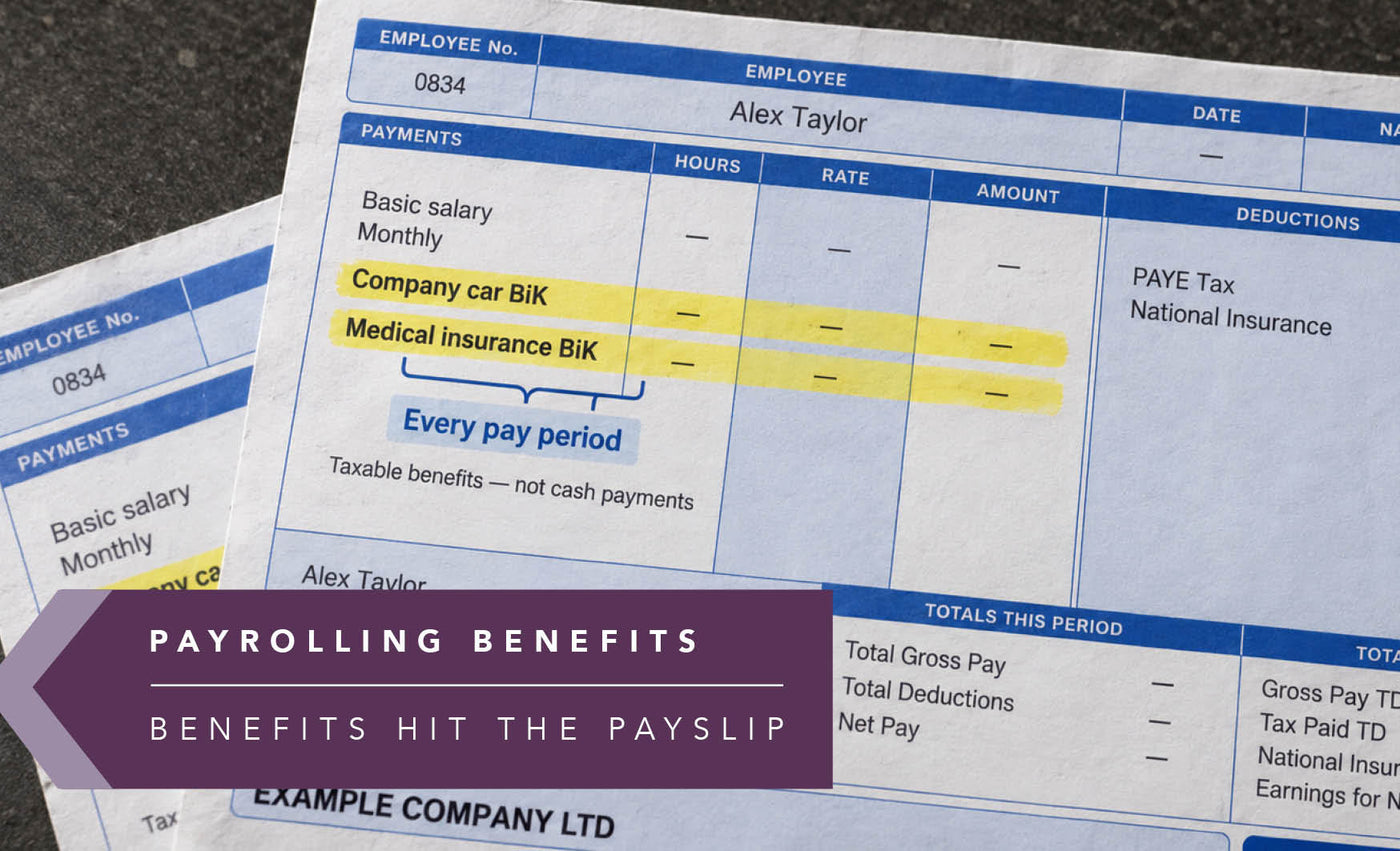
For those who have somehow missed this, payrolling benefits in kind (BiKs) means fully processing the tax on employee benefits (for example company car, medical insurance), through your payroll. This means the employer adds the cash equivalent for the benefit to taxable pay each period, so the correct taxes are collected in real timeand listed on the employee’s payslip.
This will be in place of reporting the benefit on the form P11D, but will not totally replace it, as some benefits are not mandatory. Interest-free or low-interest loans (for our clients in the main overdrawn director loan accounts) and employer-provided accommodation, are not mandatory, but are likely to come into the regime in the future.
The change gives employees more visibility into what’s being taxed and when. In due course, once the “heavy lift” of entering the scheme and completing the 2027 reporting, payrolling benefits should save time in reporting, but it is important to monitor employee benefits throughout the year, and not look at the position once a year, as tends to happen currently.
TIMELINE:
Phase 1: From 6 April 2027
- Payrolling becomes mandatory for company cars, car fuel, vans, van fuel, and employer-provided medical (and dental) benefits. The Income Tax and Class 1A National Insurance on these benefits must be reported and paid in real time through your payroll.
Phase 2: From 6 April 2028
- Most remaining benefits, such as gym memberships, non-cash vouchers and mobile phones outside the exemption, move into mandatory payrolling.
(Although you don’t have to adopt the two phases, you can set up all your benefits (other than loans and accommodation), for April 2027).
P11Ds are not disappearing overnight — you’ll still need to file P11Ds for 2025/26 and 2026/27, and for any benefits that aren’t yet in scope during 2027/28.
PROCESS
There is no registration process, provided you have registered for PAYE with HMRC. From April 2027, payrolling simply becomes the default, there’s no sign-up step to undertake.
The voluntary registration route (which some of our clients opted for) closed for 2026/27 on 5 April 2026, and HMRC is no longer accepting new voluntary registrations for that year. There’s one exception: if you want to voluntarily payroll loans or accommodation (the two benefits outside the mandatory regime), you’ll still need to register to do so. These are complicated benefits, though, and best practice may be to get everything else sorted and working before looking at these benefits, if relevant to you.
HMRC has confirmed it will remove payrolled benefits from employees’ tax codes before 6 April 2027, so they’re not taxed twice. Any underpayments from previous years will still be collected through the tax code, as happens today. However, as we always advise, and this is a new regime, everyone should check their coding notice when issued.
Suggested steps to implementation:
1. Check that your software (if you run your own payroll) or your payroll provider’s software can handle benefits, and that any necessary updates have been completed.
2. Notify employees of the change, so they aren’t shocked when they see their first payslip. It’s also worth reassuring employees that HMRC will adjust their tax codes ahead of the change, so they shouldn’t see the same benefit taxed twice.
3. Appoint someone in the business as the point of contact for employee queries, and sourcing benefits information.
4. Test your payroll setup well ahead of time to avoid any surprises.
5. Work out the annual taxable value of each benefit, divide it across the year/remaining periods in the year, and include that amount in each employee’s taxable pay.
6. Report the Income Tax and Class 1A National Insurance through your Full Payment Submission (FPS) each pay period - the same submission you already use for salaries.
7. Keep clear records of all benefits provided and adjust the figures if a benefit changes during the year. For example:
Ø If the employee changes their company car, then this will need to be updated in the month of the change.
Ø If the premium on medical insurance increases in the year, this will have to be updated.
If you don’t know the exact value of a benefit in-year, HMRC will let you payroll a reasonable estimate and then correct it after year-end. There’s a correction window up to 22 July following the end of the tax year to true up any estimates.
CASHFLOW
Cash is king, so don’t overlook the cash flow impact, as in 2027/28 you could be paying Class 1A National Insurance for both 2026/27 and 2027/28 in the same year. Model this early so it doesn’t catch you out.
PENALTIES
HMRC has said it will take a light-touch approach to penalties in the first year (2027/28), with the full penalty regime applying from 2028/29, provided errors aren’t deliberate.
We have noted that HMRC PAYE visits are back, and payrolling benefits is likely to become part of the review, so make sure any estimated benefits are calculated correctly and the supporting records are in order.
CONCLUSION
Payrolling benefits is a mandatory legal requirement, and can’t be escaped, and should in due course once bedded in, ease the tax reporting on benefits. So as not to get caught out, start planning now!